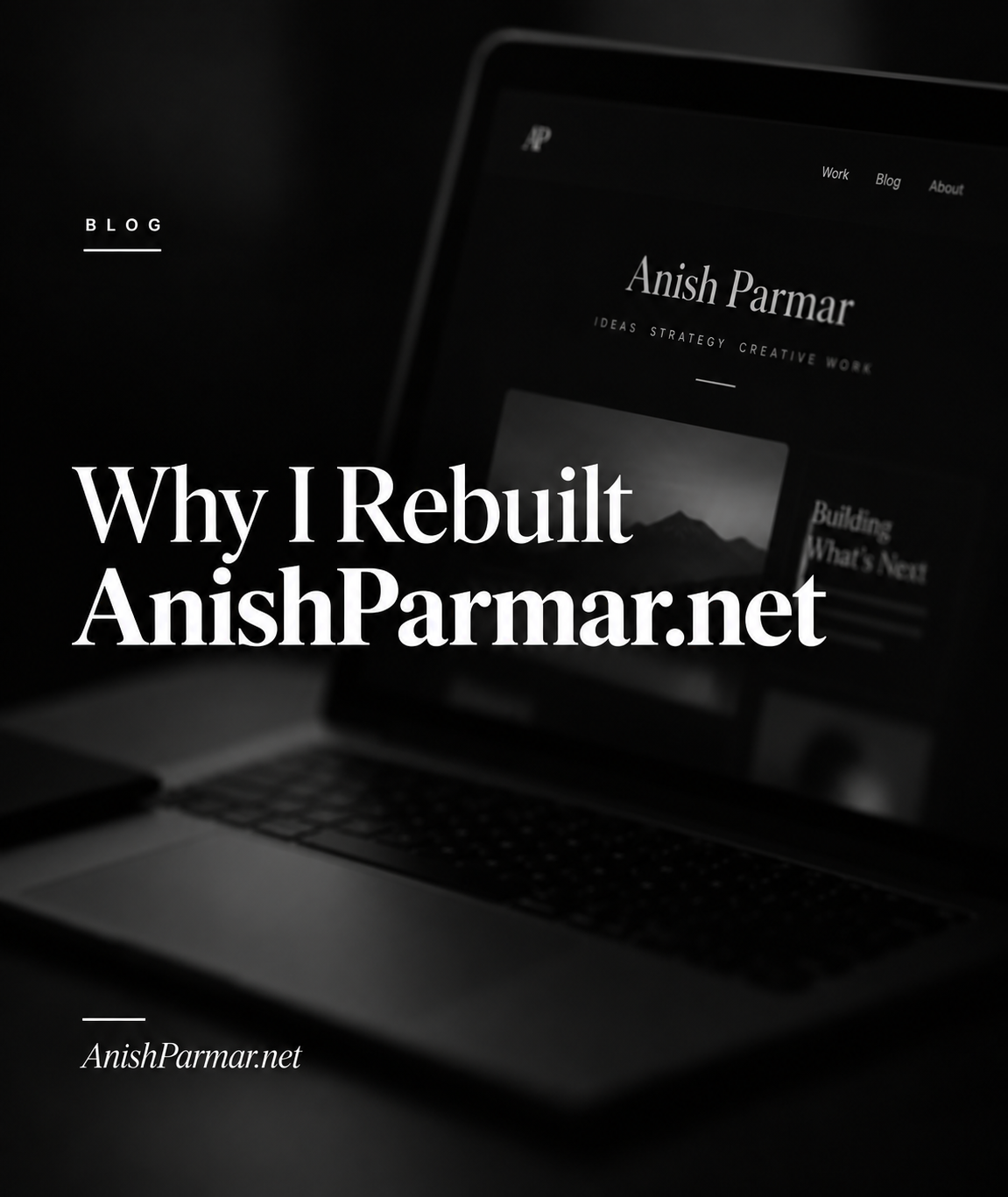
Why I Rebuilt AnishParmar.net
A personal website is one of those things that is easy to create once and then forget about.
You buy the domain, write a short biography, add a few links, publish it and move on.
The problem is that people change much faster than websites do.
Businesses evolve. Job titles change. Old photographs stop representing you. New projects become more important than the ones you were known for a few years earlier. Media coverage continues to rank long after the work it describes has changed.
That was exactly the position I found myself in with AnishParmar.net.
The old website was not necessarily wrong.
It was simply no longer an accurate representation of where I am today.
So I rebuilt it.
My Online Presence Was Still Representing an Earlier Version of Me
A large portion of my existing online presence was created during the earlier stages of my career.
At the time, my work was heavily centred around social media, digital marketing and online publicity.
That period produced a lot of the articles, interviews and profiles that still appear when my name is searched today.
Those features remain part of my story, and I have no interest in pretending otherwise.
But the work itself has evolved considerably.
Today, my interests and businesses span public relations, digital reputation, strategic positioning, digital assets, entrepreneurship and entertainment.
The old website did very little to explain that progression.
If someone searched my name and landed on it, they could understand roughly who I was, but not necessarily what I was building now.
That is a problem for any personal brand.
Your website should not simply document where you have been.
It should explain where you are.
A Personal Website Should Provide Context
Search engines are good at finding information.
They are not always good at understanding context without help.
Someone might find an article from 2020, a more recent LinkedIn profile, a company website, an old photograph and a social account all within the same search.
Each result can be individually accurate while still producing a confusing overall picture.
A personal website can help solve that.
It gives you one place to establish the current version of your identity and connect the different parts together.
In my case, that meant clearly connecting:
Anish Parmar
with
and
while also preserving the older media coverage that documents how my career developed.
The goal was not to erase the older version.
It was to provide enough context that someone could understand the progression.
The Site Needed to Reflect My Actual Work
One of the biggest reasons for rebuilding the site was that my professional positioning had become broader.
My work through Distribute PR now focuses much more heavily on media positioning, digital reputation, authority building and digital assets.
At the same time, CorpDJsrepresents an entirely different part of my professional life across corporate events, hospitality, nightlife and entertainment.
Those businesses operate in very different industries.
But they are both part of what I do.
The old version of AnishParmar.net did not properly connect them.
The rebuild allowed me to make the relationship obvious without turning the personal website into another agency site.
That distinction was important.
Distribute PR should explain Distribute PR.
CorpDJs should explain CorpDJs.
AnishParmar.net should explain Anish Parmar.
I Did Not Want Another Sales Website
This was probably the most important design decision.
It would have been easy to turn the website into a long sales funnel.
Huge claims.
Service blocks everywhere.
Aggressive calls to action.
Case studies.
Lead forms.
More calls to action.
That makes sense on a commercial website.
It did not make sense here.
I wanted AnishParmar.net to feel more like an editorial profile and digital home.
The website needed to establish who I am, show what I have worked on, archive relevant media, publish my writing and direct people towards the appropriate business when necessary.
That meant keeping the structure relatively simple:
Home
About
Media
Blog
Contact
The businesses are present, but they are not the entire website.
That makes the site more useful as a long-term personal asset.
The Media Section Needed Context Too
Rebuilding the website also made me reconsider how I present older press coverage.
A lot of my earliest media coverage was published when I was in my late teens and early twenties.
Naturally, those articles focused on what I was doing at that point in my career.
I could have removed them because the positioning is older.
I decided the opposite.
They belong on the site because they document the beginning.
Instead of trying to make old coverage look new, I created a dedicated media archive where those features can sit within the correct context.
That allows somebody to see the progression.
The earlier articles show where the journey started.
The current website explains where the work has gone since.
I think that is far more credible than rewriting your own history every few years.
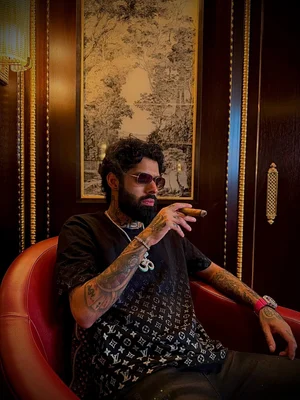
Current Photography Matters More Than I Expected
Another obvious issue was photography.
A lot of the images associated with my websites and older coverage were several years old.
Again, there was nothing inherently wrong with them.
They simply belonged to a different period.
When somebody visits a personal website, the visual identity matters almost immediately.
If the photography is five or six years behind the biography, the site starts to feel dated even when the copy is current.
That is why I now see professional photography as part of digital reputation rather than just design.
The photographs associated with your name become part of your wider online identity.
They appear on websites.
They appear in articles.
They appear in image search.
They appear on profiles.
They can stay visible for years.
A personal website therefore needs imagery that actually represents the person behind it today.
The Blog Was Another Missing Piece
The previous website told people who I was.
It did not really show how I think.
That is a missed opportunity.
A biography can establish experience, but writing can establish perspective.
The new blog gives me somewhere to document ideas around areas I am genuinely interested in, including digital reputation, public relations, digital identity, online assets, entrepreneurship and entertainment.
It also creates something more valuable than a static biography.
The website can now evolve.
New articles create new entry points.
Old ideas can be revisited.
Projects can be documented.
Opinions can change.
That makes the website a living representation of my work rather than a page that gets updated once every five years.
Owning Your Name Online Matters
There is also a broader reason I wanted to rebuild the site.
I have become increasingly interested in digital ownership.
Domains, usernames, websites, search results and online profiles all contribute to the way an identity exists on the internet.
Your name is one of the most obvious examples.
If someone searches for you, your personal domain is one of the few assets where you have complete control over the presentation.
You do not control the algorithm.
You do not control third-party publications.
You do not control what every social platform displays.
But you do control your own website.
That makes it strategically important.
The domain is not just somewhere to host a biography.
It is an owned piece of digital infrastructure attached directly to your identity.
The Rebuild Was Also About Clarity
One thing I kept coming back to throughout the redesign was simplicity.
Could somebody understand who I am within a few seconds?
Could they see what businesses I run?
Could they find my media coverage?
Could they read my writing?
Could they contact me?
Could they tell which website to visit if they wanted PR services?
Could they tell where to go if they wanted DJ or event entertainment?
If the answer required too much searching, the site was not doing its job.
Good personal branding is not about making yourself look complicated.
It is about making yourself easy to understand.
That became the central principle behind the rebuild.
Personal Websites Should Evolve With You
I do not expect this version of AnishParmar.net to remain unchanged forever.
That would defeat the point.
Five years from now, some of the things I am focused on today will probably be different.
New businesses may exist.
Existing businesses may change.
The blog will grow.
New media coverage will replace older material at the top of the archive.
The visual identity will evolve.
That is normal.
A personal website should be treated as an evolving asset rather than a finished project.
The important thing is that it remains aligned with reality.
What I Wanted the New Site to Do
Ultimately, the rebuild had four objectives.
It needed to accurately represent what I do today.
It needed to connect my businesses and wider digital presence.
It needed to preserve the history of my earlier work without allowing that history to define everything that came afterwards.
And it needed to give me a platform I actually wanted to continue building.
That is what AnishParmar.net now represents.
Not a replacement for LinkedIn.
Not another version of Distribute PR.
Not a digital résumé.
It is the central point connecting my work, businesses, media, writing and digital identity.
And, more importantly, it can continue changing as I do.