The Internet Has Made Your Name an Asset
For most of history, your name was simply an identifier.
Today, it can also be a digital asset.
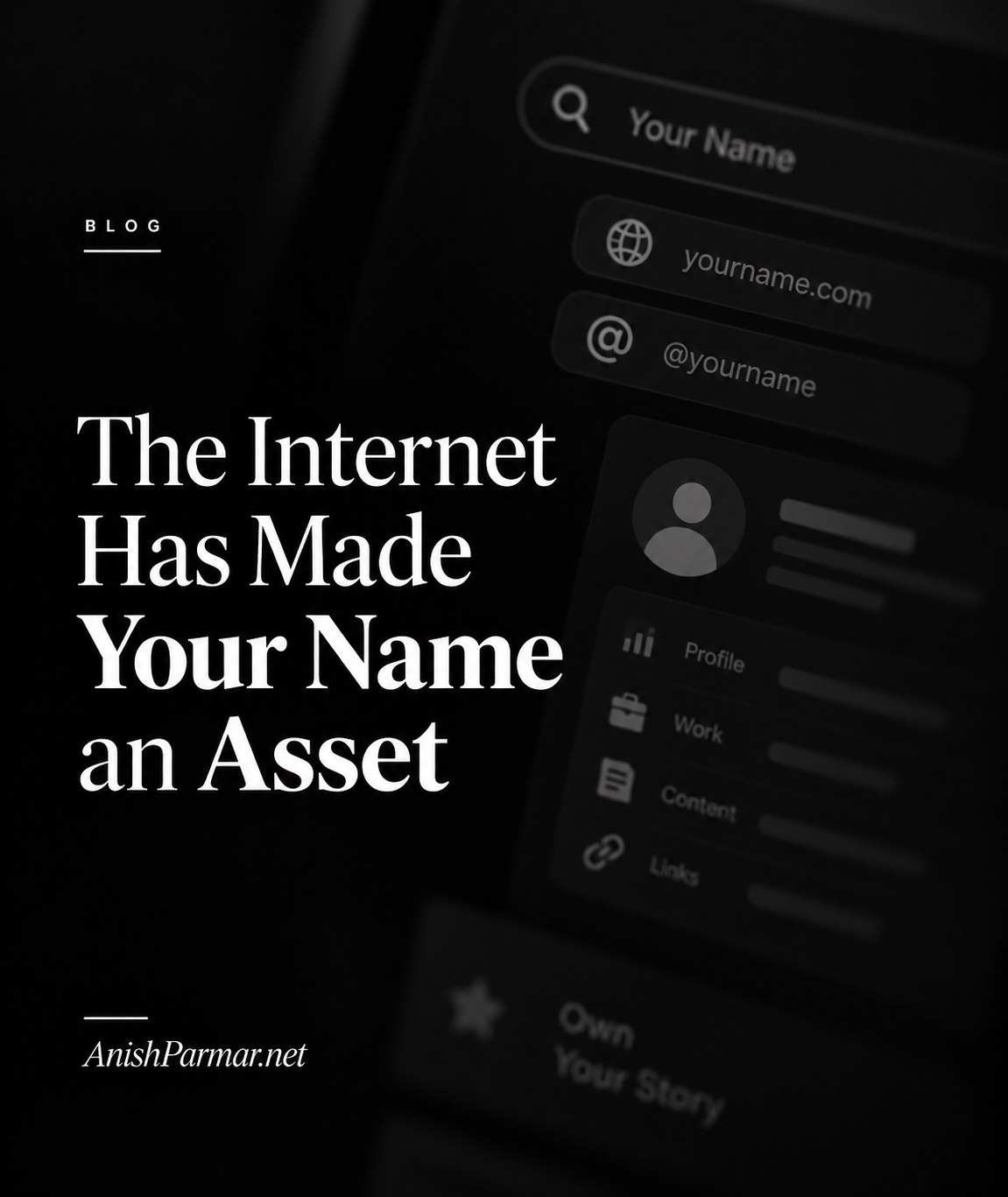
A name can have a domain attached to it. It can exist as a username across dozens of platforms. It can appear in search results, media coverage, social profiles, company websites, videos, interviews and databases.
And the more public your work becomes, the more valuable it is to control that digital identity.
This is one of the areas I have become increasingly interested in over the years.
I have always viewed domains, usernames and online identity differently from ordinary social media accounts. To me, they are not just pieces of internet infrastructure.
They are digital property.
And when they are attached to your name, company or brand, they can become part of your long-term reputation.
Your Name Now Exists Across the Internet
Think about what happens when somebody searches your name.
They might find:
Your personal website.
Your LinkedIn profile.
Your Instagram account.
Your company website.
Press coverage.
A podcast appearance.
An old article.
A YouTube channel.
An image result.
A username on another platform.
Individually, these might seem like separate properties.
In reality, they all contribute to the same thing:
your digital identity.
That identity can be clear and consistent, or fragmented and confusing.
If your name is attached to the right domains, profiles and properties, it becomes much easier for people to understand who you are.
If your presence is scattered across different usernames, outdated websites and unrelated search results, the opposite happens.
That is why I think people should stop viewing their online identity as something accidental.
It should be managed deliberately.
Your Personal Domain Is More Important Than It Looks
One of the simplest digital assets somebody can own is their own name as a domain.
For me, AnishParmar.net is more than just somewhere to host a biography.
It is an asset directly connected to my identity.
Social platforms are useful, but you do not own them.
The platform controls the rules.
It controls the design.
It controls distribution.
It can change its algorithm.
It can restrict an account.
It can remove features.
It can disappear entirely.
Your own domain is different.
You control where it points.
You control what is published.
You control the presentation.
You can rebuild the website as your career changes without losing the underlying identity.
That permanence matters.
A personal domain can become the central hub connecting everything else you do online.
Usernames Have Become Digital Property Too
Usernames are another interesting part of the equation.
Most people treat them as disposable.
They create an account, choose whatever name is available and move on.
But strong usernames have increasingly become scarce.
Short words, real names, professions, industries and culturally relevant terms are often already taken across the major platforms.
That scarcity creates value.
Not always financial value.
Sometimes the value is strategic.
A memorable username is easier to communicate.
It looks cleaner on marketing materials.
It can make a brand appear more established.
It reduces confusion.
It makes cross-platform identity easier to maintain.
There is a difference between:
@AnishParmarOfficial2026
and
@AnishParmar
The second is simply cleaner.
That matters more than people realise.
Digital Scarcity Changes Behaviour
The internet was originally built around abundance.
You could create as many web pages as you wanted.
You could open accounts on new platforms almost instantly.
But certain parts of the internet are actually scarce.
There is only one exact domain.
There is usually only one exact username per platform.
There are only so many short dictionary words.
There are only so many memorable combinations.
Once somebody owns them, everybody else has to choose something different.
That creates scarcity.
And wherever scarcity exists, people begin assigning value.
This is already obvious with premium domains.
Some domains have sold for extraordinary sums because they are short, memorable and commercially valuable.
Usernames operate on a similar principle, although the rules and ownership structures vary significantly between platforms.
The broader point remains the same.
Digital identity is no longer infinitely available.
The best assets are often already occupied.
Your Name Has Commercial Value Even If You Are Not Famous
People sometimes assume this only matters for celebrities.
I disagree.
Your name can become commercially important long before you are widely known.
Founders build companies.
Consultants build reputations.
Executives become public-facing.
Creators grow audiences.
Investors become associated with industries.
Professionals publish books.
Entrepreneurs appear in media.
Once that happens, people start searching.
And when people search, the quality of the digital assets attached to that name begins to matter.
Owning your domain early might cost very little.
Trying to acquire it years later after somebody else recognises its value can be much harder.
The same applies to usernames.
Sometimes the best time to secure an identity is before anybody else cares about it.
Search Results Are Part of the Asset
Digital identity is not only about things you technically own.
Search presence also has strategic value.
If someone searches your name and finds a coherent first page containing your website, businesses, profiles, media coverage and relevant work, that creates confidence.
The search results themselves become part of your reputation.
I explored this in more detail in my article on why Google results are part of your personal brand, but the underlying idea is simple:
A name has more value when the information attached to it is clear.
The strongest digital identity combines ownership with recognition.
You own the domain.
You maintain the profiles.
You operate the businesses.
Third parties reference you.
Search engines connect those properties.
People recognise the same person across each environment.
That creates a network effect around the name.
A Strong Digital Identity Reduces Friction
Good branding removes uncertainty.
Digital identity does the same thing.
Imagine somebody receives your name after being introduced by a mutual contact.
They search for you.
Your personal website appears.
Your LinkedIn is consistent.
Your companies are clearly connected.
Your media coverage supports the same professional identity.
Your photographs are recognisable.
Your usernames broadly align.
They immediately know they have found the right person.
That sounds basic, but it is incredibly valuable.
Now imagine the opposite.
Multiple people share the same name.
The first result belongs to somebody else.
Your social accounts use unrelated usernames.
Your website is outdated.
Your business does not mention you.
An old article presents a completely different profession.
The user has to investigate.
Every additional question creates friction.
A well-built digital identity reduces that friction.
Identity Becomes More Valuable as Your Career Develops
The interesting thing about digital assets is that their usefulness can compound.
A domain you register at 18 might become more valuable to you at 30.
A username you secured before building an audience becomes more useful once that audience exists.
A website that initially receives very little traffic can gradually accumulate links, mentions, articles and search history.
The underlying asset remains the same.
What changes is the reputation attached to it.
This is one reason I think people underestimate personal domains.
They tend to judge them based on what they do today.
The better question is what they might represent in ten years.
Businesses Have the Same Problem
The same logic applies to companies.
Before launching a brand, founders typically think about the company name, logo and website.
Increasingly, they should also think about the complete digital identity.
Is the domain available?
What do the search results look like?
Are the important usernames available?
Does another company already dominate the name?
Can customers easily distinguish the brand?
Is the name easy to communicate verbally?
Does the digital footprint support expansion?
These questions used to feel secondary.
Now they can affect the entire brand.
A brilliant company name becomes less attractive if the digital identity around it is impossible to control.
Not Every Digital Asset Is Valuable
It is important not to take this idea too far.
Scarcity alone does not create value.
A short domain that nobody wants is still a short domain nobody wants.
A rare username without relevance may have very limited practical value.
An unusual digital asset can be interesting without being commercially useful.
The same mistake happens in traditional collecting.
People assume something is valuable simply because it is uncommon.
That is not how markets work.
Value tends to come from a combination of factors:
Scarcity.
Demand.
Memorability.
Utility.
Cultural relevance.
Commercial application.
Timing.
The strongest digital assets usually combine several of these.
A good personal domain, for example, has obvious utility because it directly matches the individual who owns it.
Control Matters More Than Collection
There is also a difference between collecting digital assets and strategically controlling your identity.
I find domains and usernames interesting in their own right.
But for most founders and professionals, the objective should not be accumulating hundreds of random assets.
It should be securing the ones that matter.
Your name.
Your company.
Your important brands.
The platforms your audience actually uses.
A clean domain.
A consistent identity.
The assets should support the reputation.
Not distract from it.
Your Digital Identity Should Be Portable
Another reason ownership matters is portability.
Platforms change constantly.
One network can dominate for five years and become irrelevant over the next five.
An audience built entirely inside one platform is vulnerable to that change.
A broader digital identity is easier to move.
People know your name.
They know your domain.
They recognise your brand.
They can find you through search.
They can follow you somewhere else.
This is why I think the strongest personal brands are ultimately platform-independent.
Platforms help distribute the identity.
They should not completely own it.
Digital Real Estate Is Really About Position
The phrase “digital real estate” can sound speculative, but I think the best way to understand it is through position.
A premium physical location is valuable partly because of where it sits.
Digital assets work similarly.
A domain occupies a specific location on the web.
A username occupies a specific identity on a platform.
A strong search result occupies a position for a query.
A recognised profile occupies a position within a network.
The value comes from what that position allows you to do.
Be discovered.
Be remembered.
Build trust.
Distribute information.
Protect a brand.
Direct attention.
Create opportunity.
That is why the best digital assets are not simply collectibles.
They are infrastructure.
The Internet Has Turned Identity Into Infrastructure
This is the broader shift I find most interesting.
Your digital identity used to be an extension of your offline identity.
Increasingly, the two are inseparable.
For many people, your digital presence is encountered first.
Someone sees your name online before meeting you.
They search you before calling you.
They visit your website before deciding whether to work with you.
They review your profiles before responding to an introduction.
Your online identity is no longer secondary.
It is part of the infrastructure around your reputation.
That makes ownership increasingly important.
Start Before You Need It
The best time to think about this is before your name becomes difficult to secure.
Buy the appropriate personal domain.
Protect your company names.
Use consistent profiles.
Keep your website current.
Make important relationships between your businesses and identity clear.
Publish information worth finding.
Think carefully about the assets that may matter later.
You do not need to control every corner of the internet.
Nobody can.
But you should control enough that somebody looking for you can find the correct person, understand what you do and reach the properties you actually own.
Because your name is no longer just what people call you.
Online, it is a domain, a search query, a collection of profiles, a reputation and an increasingly valuable piece of digital property.
And the earlier you understand that, the more control you have over what it becomes.